Many new buildings today are incorporating landscaped basements and roofs.
These basements can vary from habitable spaces or Recreation areas to car parking.
The correct waterproofing should be selected for the proposed useage for the deck above a basement
Our Specialties:
- Podium decks & Buried roofs
- External Type A waterproofing
- Bund, Reservoir, Tank & Retention Pond linings and protection
- Chemical resistant coatings
- Encapsulation of hazardous materials such as asbestos
Our Systems
Disclaimer
The following information is intended as advice only, to ensure that consideration is given to the detailing of concrete decks and buried roofs, which will allow waterproofing to be installed effectively.
Skip to sections
The Structure
How different constructions compare
Concrete Deck or Buried roof?
The concrete deck or roof is a structural element and should be designed by a structural engineer, to resist dead, live and wind loads. It must also resist weather events including storms, snow and localised flooding. Finally, it must also be suitable for the proposed waterproofing system, and subsequent use.
A concrete waterproofing system for buried roofs needs to be particularly durable. Since the material will ultimately lie underneath landscaping or other finishes, it becomes very disruptive to have to make repairs if leaks occur.
You would have to remove the landscaping or other layers in order to identify where the leak is and then successfully repair it. Due of this, the concrete waterproofing process and quality control need to be effective and third party testing should be carried out on completion to ensure the waterproofing will last for the life of the building itself.
Inverted or Warm roof?
The waterproofing layer in a warm roof system is above the insulation installed above the roof deck. In an inverted roof, the waterproofing is above the roof deck, and beneath the insulation layer.
There is less risk of a leak if the waterproofing is directly on the structure as it is on an inverted roof. The consequence of a leak is less expensive and disruptive.
Joints, joins and detailing of insulation are more difficult for waterproofing. Water can track under insulation in the event of a leak, so locating a defect in the waterproofing can be difficult. For these reasons we always advise inverted over warm roof design.
The drainage system must be designed by a drainage design engineer which provides efficient drainage of water from the roof or deck. Drainage has to be maintainable and maintained. Rainwater from other roofs should always drain directly to the drainage system at ground level and not onto or via balconies or decks.
Block and beam or Concrete plank?
Block and beam and concrete plank are a quick and effective method of forming a deck, however they have to be finished with a concrete slab or a de bonded screed designed by a structural engineer so as it will not suffer from reflective or thermal cracking.
The screed has to be of the highest quality and must be tested on completion to confirm strength and compaction before application of primers and coatings.
Reinforced Concrete... The clear winner!
Podium Decks constructed from reinforced concrete and correctly designed by a competent engineer have proven to be the most reliable, according to third party insurance companies.
For Warranty purposes, Podium Decks constructed of block and beam floors or pre-cast concrete planks are not acceptable for any podium deck or buried roof applications.
Screeds can be used to achieve falls. The screed has to be of the highest quality and must be tested on completion to confirm strength and compaction before application of primers and coatings.
Drains and outlets must be designed and installed so water will run off uninhibited.
3D Section / Our Deck Waterproofing System
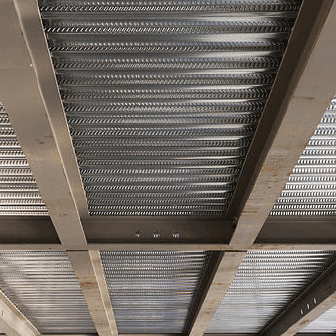
What about metal decks?
It is not possible to achieve a defined datum level when constructing concrete slabs when installed on metal decking.
Deflection will occur which could lead to ponding. If there is a defect in waterproofing over a metal deck it will not be possible to establish the point of damage or defect by water testing.
Detailing
It is a requirement of third party warranty holders that waterproofing of buried roofs and decks is designed by a CSSW Qualified specialist (Certified Surveyor Structural Waterproofing).
This is critical to avoid split liability.
All posts and fittings should be detailed by the concrete waterproofing specialist to ensure a complete and effective water proofing design and installation.

Rainwater pipes and Service Penetrations
- Must be at least 100mm clear of walls so effective waterproof detailing can be installed.
- Where penetrations through a roof slab can be avoided they should be.

Sky lights & planters
- The construction and detailing of skylights and planters must be agreed with the concrete waterproofing specialist designer.
- The construction sequence must be agreed, as additional visits may be required for detailing.


Thresholds
- Must be designed with the waterproofing specialist designer.
- They are a critical element and often overlooked in the deck waterproofing specification.


Upstands and Downturns
- Have to be considered with the specialist concrete waterproofing designer.
- The down turns have to be 150mm below any internal waterproofing system, or lap on to external waterproofing systems.
Drainage
The design of new Buried roofs and concrete decks should provide efficient removal of water to the designated drainage points. The design must also be maintainable whilst at the same time be regularly maintained.
The drainage system must be designed by a drainage design engineer which provides efficient drainage of water from the roof or deck. There must be no back-falls or ponding on the roof. It is always better to design to falls to minimise risk.

Negative falls will result in ponding water which increases the localized load and the amount of water that could drain into the building through any defect or damage.
Finished concrete decks must be flood tested or analyzed by an engineer to confirm the deck is completely flat or to desired falls.
Ponding water will have a cooling effect on the roof deck below and so reduce the thermal performance
Surface Preparation For Concrete Waterproofing
Grinding it, vacuuming it, checking the temperature, checking the moisture content, checking the humidity. There is a lot more to concrete waterproofing than just applying product.
Firstly, the area needs to be prepared by making sure it is clean and dry. To be assured of maximum adhesion of our system and to prevent outgassing, the correct surface preparation is essential. Substrates are mechanically prepared to remove all laitance, loose material, and contamination.
Concrete and Screed Surface Finishes
Concrete/screed surfaces must be smooth and level, tamped concrete and ridges must be ground down. Ridges lead to shadowing in sprayed finishes which can cause defects and also more material is required for coatings.
Salt
Any project in close proximity to the sea risks contamination by air borne salt. Protection of concrete on completion of pouring is critical. Old concrete must be properly tested and prepared. Priming is critical and additional priming will be necessary to prevent the risk of osmosis as a result of salt contamination.


Laitance
New concrete will often develop a layer of laitance on the surface. This weak, powdery layer prevents proper adhesion of any waterproofing system. Laitance consists of water, cement, and very fine aggregates that rise to the surface during compaction, forming a thin crust above the sound concrete.
Laitance may also be present on old concrete unless the surface has been previously prepared.
This layer must be mechanically removed, typically by grinding, back to sound concrete and aggregate.
All surfaces must be clean and dry, free from dust, dirt, oil, grease, curing compounds, or any other contaminants that may impair adhesion of the new waterproofing system.
Voids, cracks, holes, honeycombing, and any other damaged horizontal or vertical surfaces must be repaired prior to the application of the waterproofing.
Do you need expert advice on Waterproofing?
Weather & Environmental Conditions
Site must be free from surface water, ice or snow prior to installation and with no forecast of rain for 48 hours after priming and 6 hours after work completion

Waterproof systems typically require an Ambient temperature of 5° and rising, 3 degrees above dew point and visually dry surfaces.*
*Some systems state 5% moisture or below 75% humidity.
De watering and drying is the responsibility of the site. The site are to provide a visually dry slab by either keeping it covered with tenting or drying with vacuums, squeegees and heaters prior to arrival of waterproofing Contractors so water will run off. uninhibited.
We advise all of our clients that deck waterproofing work must happen in the spring and summer. Winter work will be difficult, there could also be delays and additional costs.
In winter months or for time critical projects the deck must be fully covered with a temporary structure. All areas have to be visually dry.
Sequencing
Work should ideally be programmed for April to October and should not be time critical as it will always be weather dependent.
Programming of the waterproofing can be difficult. Concrete typically takes 28 days curing before any concrete waterproofing systems can be applied. Some primers and conditions could reduce this time.
A well thought out program will allow an extended program slot for waterproofing external decks and walls, before critical elements of construction are required. Delays are likely and, in the Winter, they are inevitable and should be planned for.
During construction, buried roofs and decks are often used for storage by other trades, site huts, or to provide access to the building itself. If the waterproofing is installed before the deck is used it can be damaged by follow on trades, usage and traffic.
If the concrete waterproofing is installed later in the program, the areas below could become unacceptably wet which will lead to prolonged drying out and potential damage to new finishes.
Consideration should be given to waterproofing as soon as possible including detailing all joins and upstands and down stands so as finishing work can proceed but with only temporary waterproofing with suitable protection over the main unfinished deck area until traffic and use on the slab is complete and it is ready for permanent finishes.
Or complete the waterproofing as soon as the deck is ready and install trafficable protection but revisit , check and repair waterproofing on completion of builders work but before landscaping and finishes.


Why should I work with MacLennan for my concrete waterproofing?
WE’RE INDEPENDENT
We Design, supply and install. There's no split responsibility with MacLennan.
WE’RE PASSIONATE
MacLennan live and breathe waterproofing, have a look at one of our free CPD seminars and find out!
WE’RE GUARANTEED
MacLennan has the most comprehensive guarantees and insurances in the industry.
Related Details


Related Projects

Grand & Luxury, New Build Home
Case Study / Waterproofing Grand & Luxury, New Build Home A specialist Waterproofing solution, for […]

Deck Waterproofing Case Study / 19th century house, Wiltshire
Case Study / Deck Waterproofing 19th Century House, Wiltshire Waterproofing a deck above an indoor […]

Waterproofing Case Study / Wembley Stadium, London
Case Study / Waterproofing Wembley Stadium, London Deck Waterproofing Wembley Stadium The stadium concourse was […]
What else do you need to think about when waterproofing a basement?